


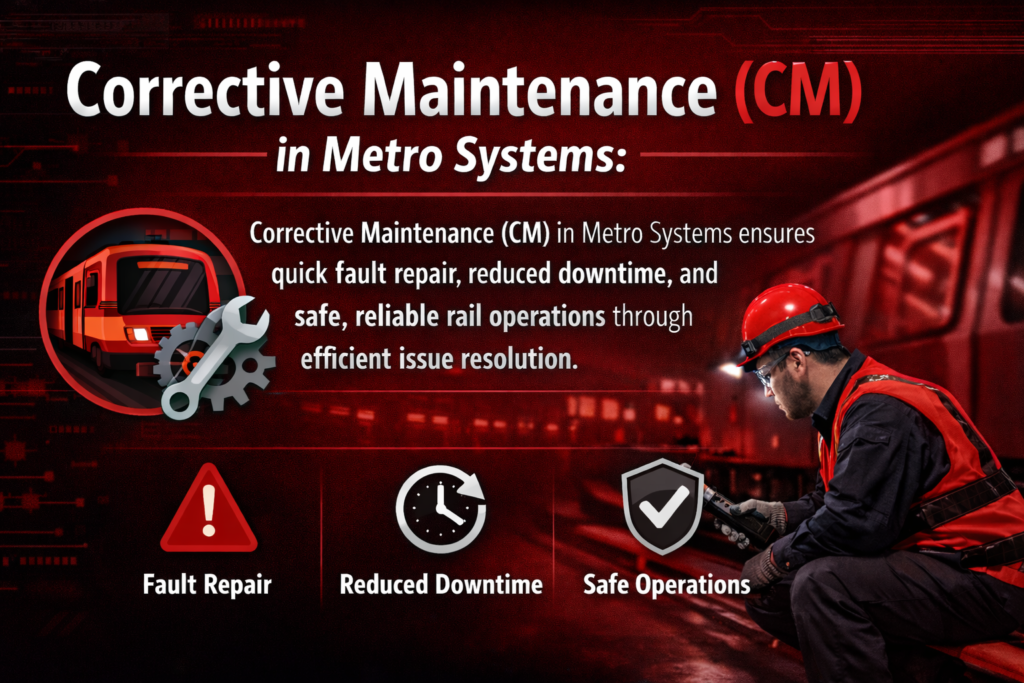
Metro rail systems are built with care, planning, and layers of safety. Trains are inspected, tracks are monitored, and signals are tested regularly. Even with all this preparation, metro rails operate in the real world, where weather changes suddenly, components wear unexpectedly, and systems face constant pressure.
When something does go wrong, metro rails don’t panic.
They respond.
That response comes through corrective metro rail maintenance and emergency metro rail maintenance, the part of metro rail care that steps in after a problem appears and ensures safety is restored before anything else continues.
These maintenance actions may be unplanned, but they are never unprepared.
Understanding Corrective metro rail Maintenance in Simple Terms
Corrective metro rail maintenance is the process of fixing something that has already failed or stopped working properly.
If a fault is detected in a train, a track component, or a system and it affects performance or safety, corrective maintenance is triggered. The goal is to identify the problem, fix it correctly, and restore safe operation.
This type of maintenance is reactive by nature, but that doesn’t make it careless or rushed. In fact, corrective maintenance follows clear procedures designed to ensure accuracy and safety.
Corrective maintenance usually involves:
- Detecting a fault
- Assessing its impact
- Repairing or replacing the affected part
- Testing the system before returning it to service
It is about restoring normalcy responsibly.
When Maintenance Becomes Urgent: Emergency metro rail Maintenance
Some situations demand immediate attention. This is where emergency metro rail maintenance comes in.
Emergency maintenance is required when a fault poses a potential safety risk or causes significant service disruption. These situations cannot wait for regular schedules or routine planning.
Examples include:
- Sudden track damage
- Critical signal failures
- Electrical faults affecting train movement
- Infrastructure damage due to weather or external impact
In such moments, speed matters, but safety matters more.
Emergency maintenance teams are trained to act quickly while still following strict safety protocols. Even under pressure, decisions are made carefully, with passenger and staff safety as the highest priority.
Unscheduled metro rail Maintenance: Responding to the Unexpected
Both corrective and emergency maintenance fall under unscheduled metro rail maintenance.
Unlike planned or routine maintenance, unscheduled maintenance happens outside the timetable. It is triggered by real-time events rather than preset schedules.
Unscheduled maintenance reminds us of an important truth:
No system, no matter how advanced, can predict everything.
metro rails prepare for this reality by building strong response frameworks—clear communication channels, trained teams, and defined safety procedures—so that when plans change, responses remain steady.
Fault Rectification: Fixing the Cause, Not Just the Symptom
At the heart of corrective maintenance is fault rectification.
Fault rectification is not just about replacing a broken part. It is about understanding why the fault happened and ensuring the solution is reliable.
This process often includes:
- Examining surrounding components
- Identifying root causes
- Checking whether similar issues could occur elsewhere
- Verifying system performance after repair
Effective fault rectification prevents repeat failures and strengthens the overall system.
It is careful work done quietly but with long-lasting impact.
metro rail Safety Response: Safety Comes Before Speed
Whenever a fault is detected, the first response is not repair; it is safety.
metro rail safety response includes all the actions taken to protect passengers, staff, and infrastructure before maintenance work begins.
This may involve:
- Slowing down or stopping trains
- Isolating affected sections
- Redirecting services
- Informing control centres and operations teams
Maintenance teams work closely with operations and safety personnel to ensure risks are controlled before repairs start.
This coordination ensures that even during disruptions, safety is never compromised.
Why Corrective Maintenance Still Matters Today
With modern technologies like predictive and preventive maintenance, it may seem like corrective maintenance should no longer be needed. In reality, it remains an essential part of metro rail systems.
metro rails operate across vast networks and varying conditions. Not all faults can be predicted, and not all wear follows patterns.
Corrective metro rail maintenance ensures that:
- Unexpected issues are handled responsibly
- Services can be restored safely
- Systems remain resilient rather than fragile
It acts as a safety net, ready when prevention is not enough.
The Human Side of Emergency Maintenance
Emergency metro rail maintenance brings out the human side of rail operations more than any other maintenance type.
Teams respond late at night, early in the morning, and during difficult conditions. They work quietly, often unseen, restoring systems so journeys can continue.
Passengers may only notice a short delay or a brief announcement. Behind that moment is a coordinated effort involving inspection, decision-making, repair, and safety checks.
When trains start moving again, emergency maintenance has already done its job.
Balancing Urgency with Responsibility
One of the greatest challenges in corrective and emergency maintenance is balance.
Act too slowly, and disruptions increase.
Act too quickly, and safety could be compromised.
metro rails manage this balance through:
- Clear emergency procedures
- Well-trained maintenance teams
- Strong communication between departments
- Experience gained over time
Preparedness ensures that even under pressure, actions remain calm and controlled.
Corrective and Preventive Maintenance: Working Together
Corrective maintenance is sometimes misunderstood as a failure of planning. In reality, it complements preventive strategies.
Preventive maintenance reduces risk.
Corrective maintenance manages reality.
Together, they create a complete maintenance system—one that plans carefully and responds responsibly.
The goal is not to eliminate corrective maintenance but to ensure it is handled well when needed.
Conclusion:
Corrective and emergency metro rail maintenance represents the metro rail’s ability to respond with care when things don’t go as expected.
Through corrective metro rail maintenance, faults are identified and resolved through thoughtful fault rectification. Through emergency metro rail maintenance, urgent situations are handled with discipline and a strong metro rail safety response.
These actions may be unscheduled, but they are never unplanned in spirit.
They exist to protect safety.
They exist to restore trust.
They exist so that metro rails can continue to move reliably, responsibly, and confidently.
Understanding these maintenance practices helps us see metro rails not just as systems that run, but as systems that adapt, even when challenged.